
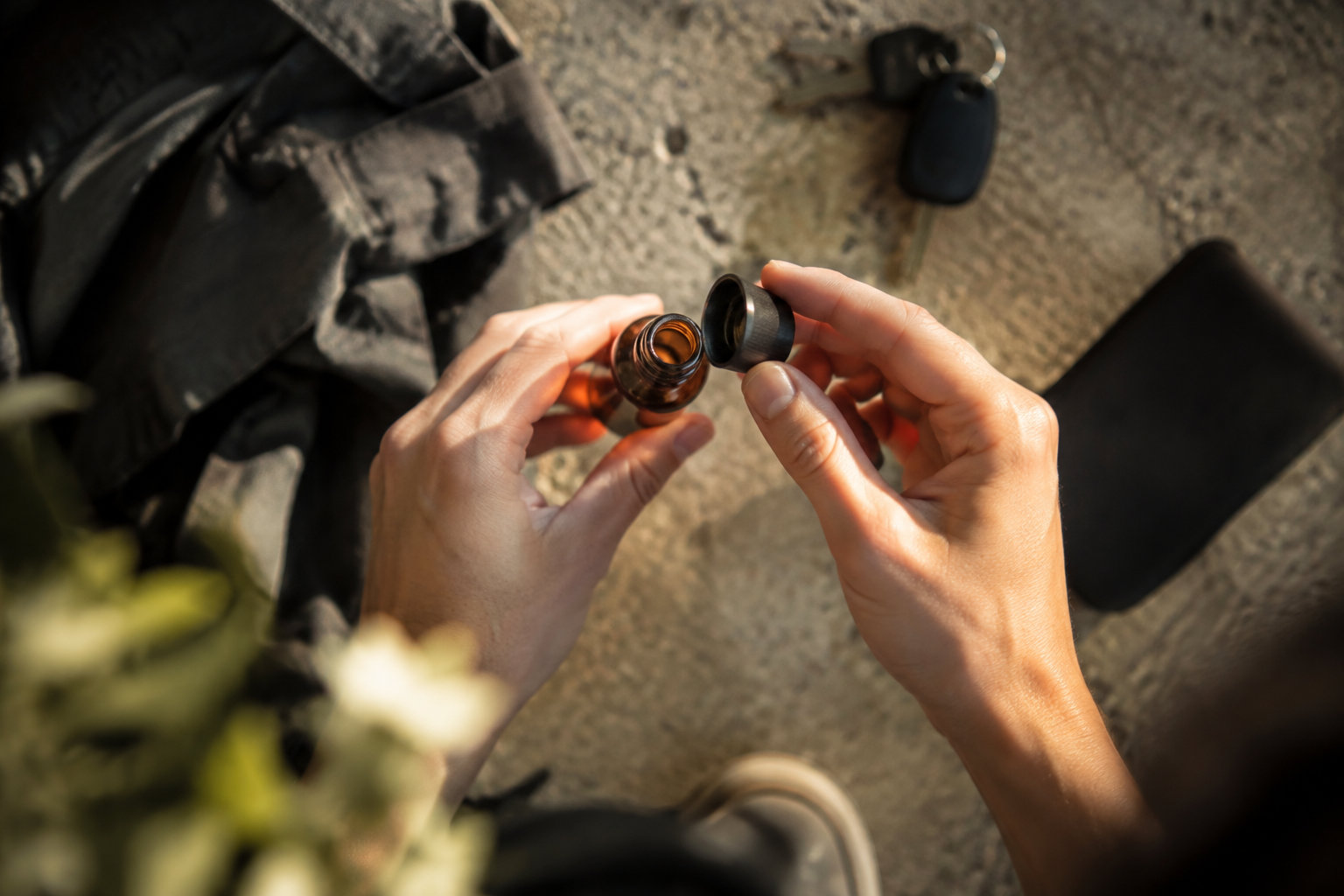
Poppers are sold in small bottles, often labeled as room deodorizer or leather cleaner. Behind that label is a chemical that drops your blood pressure fast.
The label hides what you are actually breathing in. This article explains what alkyl nitrites are, how they work, whether they are legal in the US, and what the risks are.
So what exactly are alkyl nitrites?
Alkyl nitrites are volatile liquids, which means they turn into vapor easily. Each molecule has a chain of carbon atoms, the alkyl group, joined to a nitrite group.
Change the chain and you get a different compound. Amyl, butyl, isobutyl and isopropyl nitrite are the main ones in poppers.
The name comes from the sound. Early products came in small glass ampoules, and breaking one made a pop as the vapor escaped.
Today’s bottles are sealed because these liquids evaporate fast, so the seal keeps the product in. Treat that bottle as the chemical it is, not as a harmless gadget.
What they do to your body in the first minute
About 30 seconds after you inhale, the nitric oxide they release reaches your blood vessels. An enzyme called guanylyl cyclase switches on, the muscle in the vessel walls relaxes, and the vessels widen. Blood pressure drops.
Your heart notices the drop and beats faster to make up for it. The rush lasts 3 to 5 minutes, but the extra work on your heart doesn’t stop when the buzz does.
Verdict: a few minutes of buzz is not worth a heart working overtime.
Amyl, butyl, isobutyl, isopropyl: how they differ
Amyl nitrite
Amyl nitrite is the oldest of the group, and the one that gave poppers their name. In 1867, Thomas Lauder Brunton used it to ease angina, the chest pain that comes when the heart gets less blood.
Quite a career change for a chemical now sold in small bottles. Doctors dropped it later: nitroglycerin took over in the late 19th century because it lasted longer and was easier to use.
Butyl and isobutyl nitrite
n-Butyl and isobutyl nitrite share the same formula, C4H9NO2, but they are two different molecules. Isobutyl boils at about 67°C, while n-butyl boils at about 78°C.
Both are named in federal law, so the ban covers each one. The strength ranking is only a general comparison, and it says nothing about a specific bottle. Don’t pick one because its name sounds milder.
Isopropyl nitrite
Isopropyl nitrite
-
Lower boiling point
It boils at about 39°C, lower than amyl, butyl and isobutyl nitrite. So it evaporates faster.
-
Eye damage
Case reports link it to maculopathy, damage to the central part of the retina. Some people noticed vision changes after repeated use. Don’t skip this one.
-
Warning sign
Stop using the product right away. Seek urgent medical care for sudden vision loss.
Are alkyl nitrites legal in the US?
In the US, federal law bans butyl nitrite as a hazardous product. That covers every butyl form, mixtures included.
Isopropyl nitrite and other volatile alkyl nitrites are banned too when they’re sold as consumer products to inhale or take for a high.
There are exceptions for specified commercial uses and for uses approved under the Food, Drug, and Cosmetic Act, but not for poppers sold to be used recreationally.
The FDA still tells you not to buy them for fun or sex, whatever the label says.
A bottle sold as an air freshener is still a poppers bottle, so walk past it.
Why they get sold as cleaners and what they were used for
Ever seen poppers sold as leather cleaner or room deodorizer? That’s the trick. The label changes the name, not the chemical. So a bottle marked “tape-head cleaner” is no safer to sniff than one that says poppers.
Amyl nitrite was a real medicine. Doctors prescribed it for angina from 1867, until nitroglycerin replaced it in the late 1800s. It was also once in some cyanide-poisoning kits, but in the US it’s no longer the first treatment.
If you need leather cleaner, buy leather cleaner. Keep any bottle that smells like poppers far from your nose.
The health risks and warning signs you need to know
Oxygen and blood problems
Poppers can stop your blood from carrying enough oxygen. Doctors call this methemoglobinemia. Watch for headache, dizziness, nausea, trouble breathing, confusion, or blue or gray skin. These signs can appear soon after use.
Swallowing them exposes you to far more nitrite than sniffing. Severe cases can cause seizures, coma, heart rhythm problems or death. If you notice these signs, call emergency services now. Don’t wait to see if it passes.
Heart and blood pressure dangers
The heart risks are the scariest, and they can hit fast. Here’s what to know:
- Poppers have been linked to reports of death and hospitalization, with extreme drops in blood pressure.
- Never mix them with sildenafil or tadalafil. Blood pressure can fall to an unsafe level, causing dizziness, fainting or serious harm.
- Repeated use of highly concentrated inhalants can cause sudden heart failure and death within minutes.
Eyes and long-term use
Repeated popper use has been linked to blurry vision, light sensitivity and blind spots, and isopropyl nitrite has been linked to maculopathy, a damage to the central retina. Blind spots are never something to brush off. If your vision changes after use, stop right away and call Poison Control at 1-800-222-1222, or 911 for a medical emergency.
How they compare to nitrous oxide
Nitrous oxide is a gas, not an alkyl nitrite. It blocks NMDA receptors in the brain, which is how it dulls your senses. Poppers work on your blood vessels instead, relaxing the muscle around them.
A popper hits in about 30 seconds, and the rush lasts 3 to 5 minutes. Nitrous oxide takes about a minute to act, but recovery takes 10 to 15 minutes.
Nitrous use also carries its own risk. Used often, it can knock out vitamin B12 and damage your nerves, leaving numbness, weakness and harm to the spinal cord. Neither is a safe party drug, so leave both alone.
Poppers are not a harmless bottle. They drop your blood pressure fast, leave your blood with less oxygen, and can damage your vision. If anything goes wrong, stop and call 911 or Poison Control.
Your next step: if you own a bottle, stop using it right away. And if you take sildenafil or tadalafil, don’t touch it at all. ⚠️
Frequently asked questions
Does amyl nitrite show up on a drug test?
No, a standard drug test won’t detect amyl nitrite, because those screens aren’t built to look for alkyl nitrites.
Only a specialist toxicology test can find them. Don’t count on a usual screen to clear you, since it isn’t checking for this at all.
What is an alkyl nitrate, and is it legal?
An alkyl nitrate is a different chemical group from an alkyl nitrite, despite the similar name. Federal law bans alkyl nitrites sold to inhale for a high, but it doesn’t say that every alkyl nitrate has the same legal status.
What’s the difference between amyl nitrate and butyl nitrate?
Amyl nitrate and butyl nitrate are a label trick: products sold under those names usually contain alkyl nitrites, not nitrates. The only real difference is the carbon chain: amyl nitrite has five carbon atoms, and butyl nitrite has four.
Is isopropyl nitrite regulated differently from butyl nitrite?
Only on paper. Both fall under the same federal ban on consumer products sold to inhale for a high, but butyl nitrite gets its own provision naming its forms, while isopropyl nitrite falls under the general volatile alkyl nitrite rule.